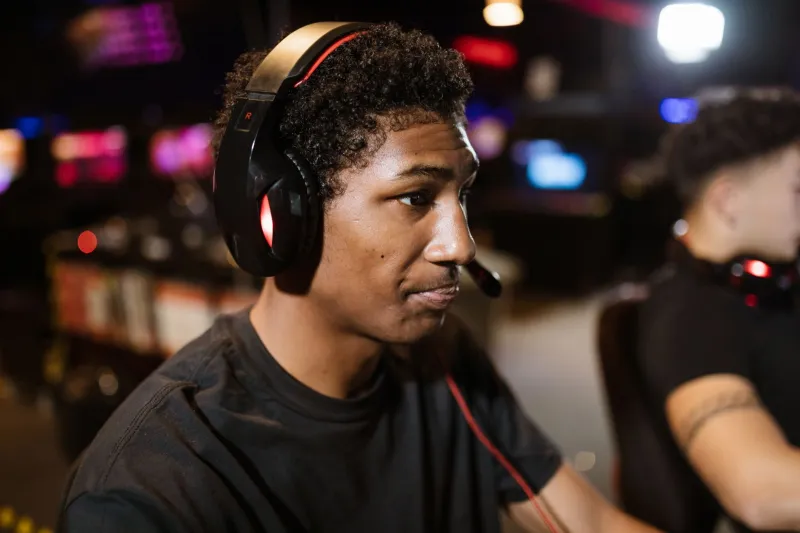
Stars Who Crack: Why Your Best Fragger Falls Apart and Your Quiet Support Player Never Does

Every team has that guy. The one who absolutely cooks in practice. Fifty-bomb average in scrims, highlight clip every other round, the kind of aim that makes you think you're watching a bot lobby. Then the tournament bracket hits, the stream goes live, and suddenly he's whiffing shots he'd make in his sleep. Meanwhile, your support player — the one who flashes for everyone, plays off-angles, and never really tops the scoreboard — is somehow calm, consistent, and quietly winning rounds.
If you've been in competitive gaming long enough, you've seen this pattern repeat itself. It's not a fluke. It's not nerves in the simple sense. It's a deep psychological phenomenon that pro analysts, sports psychologists, and team coaches are only now starting to fully understand — and it has everything to do with how different roles relate to identity and expectation.
The Duelist Trap
Let's start with what makes a duelist — or a star fragger, whatever you call them in your game of choice — so vulnerable under pressure.
Players like Demon1 (VALORANT) or Shiro (older CS) built their entire competitive identity around mechanical output. Kills per round, rating, opening duel percentage — these are the metrics their value is measured by, and more importantly, the metrics they measure themselves by. That's not a criticism. That identity is often exactly what drives them to grind their aim to an elite level in the first place.
But here's the problem: when the stakes spike, the brain activates a threat-response system. And for players whose self-worth is tightly bound to performance output, every missed shot isn't just a missed shot. It's a threat to identity. The psychological weight of each individual duel becomes enormous — and that weight is what tanks performance.
Sports psychologists call this ego-threat sensitivity. The higher a player's identity is fused with their role performance, the more intensely they experience failure — and the more cognitive resources get redirected toward managing that emotional response instead of, you know, actually playing the game.
Result? Hesitation. Overcorrection. The dreaded "thinking too much" that every fragger has experienced but nobody knows how to fix.
Why Support Players Are Built Different (Psychologically)
Now flip it. Your support player — the one running flashes, taking the unfavorable trade, playing for information — operates in a completely different psychological environment.
Their success metrics are diffuse. Did the flash land? Did the teammate get the kill? Did the rotation work? These outcomes are distributed across the team, not concentrated in a single mechanical moment. When a support play fails, the attribution is shared. When it succeeds, the credit is shared. That psychological spread acts as a buffer against ego-threat.
Support players also tend to develop what researchers call process orientation — their satisfaction comes from executing a role correctly, not from the outcome of a specific duel. That mindset is naturally more resilient under pressure because the brain isn't treating every round as a referendum on personal worth.
This isn't to say support players don't feel pressure. They absolutely do. But the structure of their role creates a psychological safety net that star fraggers simply don't have by default.
Recent Pro Data Backs This Up
Look at tournament performance data from major VALORANT and CS2 events over the last 18 months and a pattern emerges: entry fraggers and primary duelists show the highest variance between regular season play and playoff performance. Their peaks are higher, but their floors are lower.
Support and utility-heavy players, by contrast, show tighter consistency across both contexts. Their ceiling might be lower in terms of raw numbers, but they're delivering closer to their average when it matters most.
Teams that have found ways to break this pattern — NaVi's approach with s1mple before his retirement, or how 100 Thieves has structured roles around protecting their primary fragger's mental load — tend to do it through explicit psychological coaching, not just mechanical training.
The takeaway isn't that duelists are mentally weak. It's that the role itself creates conditions that require specific psychological tools most teams never bother to develop.
Training the Fragger's Mind
So what do you actually do about it? If you're a star player, or you coach one, here are the approaches that are showing up in pro training programs:
Detach the stat line from the identity. This sounds simple and it's brutally hard to execute. The goal is to create a psychological gap between "I am a player who takes duels" and "I need to win this duel to be valuable." Journaling after sessions, focusing on process metrics (positioning, decision timing, peek quality) rather than outcome metrics, and deliberately reviewing rounds where you lost the duel but made the right call — all of this builds that separation over time.
Simulate pressure in practice, not just skill. Most aim training happens in zero-stakes environments. Deathmatch, aim trainers, private lobbies. The mechanical skill transfers. The pressure doesn't. Teams that create internal pressure environments — consequence-based scrims, public VOD reviews, role-reversal drills where the fragger has to play support — are building stress inoculation that pays off in bracket play.
Reframe the role narrative. Some pro coaches have had success reframing what it means to be an entry or duelist. Instead of "you need to win duels," the framing becomes "you need to create chaos and information." Winning the duel is one outcome. Forcing a rotation, burning utility, or drawing attention are also wins. That reframe reduces the psychological weight on any single mechanical moment.
Build a pre-round routine. This is standard in traditional sports and criminally underused in esports. A consistent physical and mental routine before each round — breathing pattern, a specific callout, a physical reset — acts as an anchor that pulls the nervous system back toward baseline. It's not magic. It's just behavioral regulation, and it works.
The Bigger Picture
Here's the uncomfortable truth for teams that are built around one mechanical superstar: you might be setting that player up to fail by not investing in their mental framework the same way you invest in their aim.
Shooters at the highest level are not separated by who has the better flick. At tier one, everyone can aim. What separates champions from almost-champions is who can access their skill under the specific conditions that matter — big stage, last round, one life left.
Your support player might already know something your star fragger doesn't. The goal isn't to make your fragger think like a support. It's to give them the psychological tools to carry their role without being crushed by it.
Aim true, play hard — but play smart about how you build the mind behind the mouse.